

TOCA ·Keyless-Go Security
What you need to know.
Relay Attack Protection
No Power Needed
Instant Effect
Why a car key should be shielded
Vehicles with Keyless-Go open automatically as soon as the key is nearby. The key does not have to be pressed, it transmits continuously. In a relay attack, two people intercept that signal, amplify it and forward it to the vehicle. The car opens as though the key were right beside it. The whole process takes under 60 seconds, with no broken window and no alarm.
Vehicles from almost every major manufacturer of the past 15 years are affected. The vehicle is not the weak point. The key is.
What a Faraday pouch for a car key does
A Faraday key pouch is lined with a conductive shielding fabric. When the key lies fully closed inside, its radio signal is blocked. No signal, no relay attack. The shielding works passively, with no battery and no electronics.
The closure is decisive. A loosely folded sleeve, or one with damaged shielding, does not protect reliably. Look for a roll-top or fold-seal closure.
How to test the shielding
- Put the key in the pouch and close it completely.
- Walk up to the vehicle and try to open it. It should not respond.
- Press the unlock button while the key is inside the pouch. The vehicle should not respond.
If the vehicle responds to either test, the pouch is not blocking effectively.
Protection away from home too
Most advice focuses on protection at home. But relay attacks also happen in shopping centres, car parks and restaurants, anywhere the key is carried in a jacket or bag. A compact key pouch protects in both situations.
Read more: Keyless Go Theft: How Relay Attacks Work and How to Protect Your Car
TOCA designs and produces signal-blocking sleeves and bags. DEKRA certified. Designed in Germany. Built for everyday use.
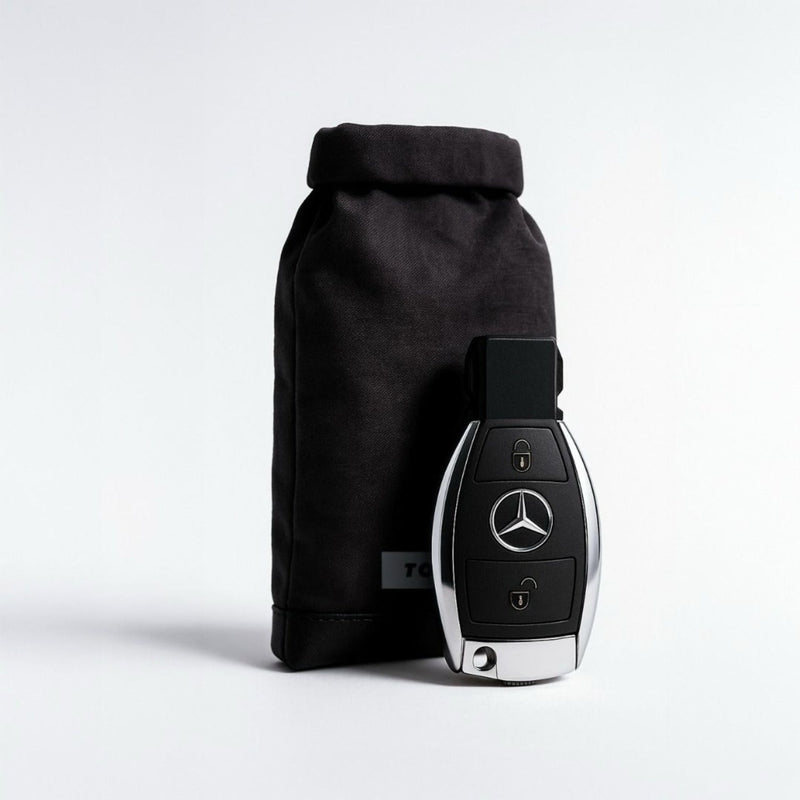
Keyless-Go Security
The key transmits. Continuously.
Without complete signal blocking, the vehicle remains vulnerable. The pouch blocks the signal passively, without battery and without electronics.

FAQ
Frequently Asked Questions
Which cars are affected by relay attacks?
Every vehicle with a passive keyless entry system that opens without a button press as soon as the key is nearby. That covers most models from the past 15 years.
Is it enough to keep the key away from the front door?
That reduces the risk but does not remove it. Relay amplifiers are powerful and can pick up signals through walls. Only full shielding is reliable.
Does a Faraday pouch work for the spare key too?
Yes. It makes sense to shield both keys, since an unprotected spare key in the house offers the same point of attack.