


TOCA ·Shielding on the Body
What you need to know.
Device Stays Connected
Body-Side Shielding
No Power Needed
What this page is about
A phone in your pocket and a laptop on your lap have the same problem: the device is transmitting and your body is right next to it. Unlike deliberately going offline, you want to keep using the device while that happens.
The products here solve exactly that case. They reduce radiation on the side facing your body without taking the device off the network. You stay reachable, you keep working, and exposure drops.
Why distance from the body matters
A smartphone's SAR value is established under defined test conditions. Those conditions assume a minimum distance from the body. Apple recommends at least 15 mm for the iPhone, and other manufacturers state similar figures. Carrying the device directly against the body puts you outside those test conditions.
Electromagnetic fields fall off with the square of the distance. A few centimetres already make a difference. Germany's Federal Office for Radiation Protection recommends reducing personal exposure as a precaution wherever it can be done without significant effort.
Check your device's SAR value for free with the TOCA SAR Checker.
Two constructions, one goal
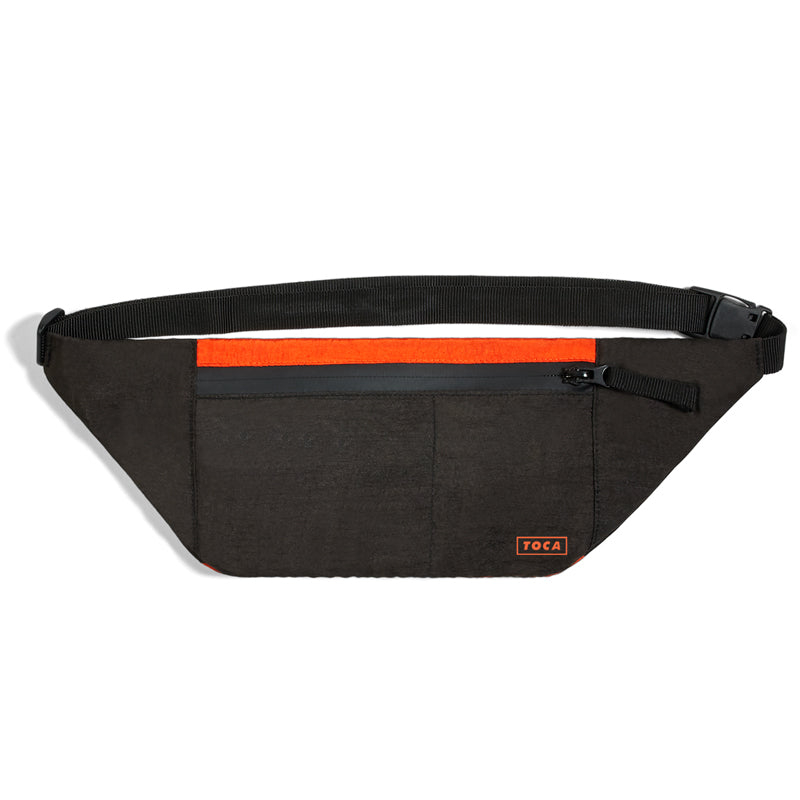
One-sided shielding, for the phone. The shielding layer sits between the device and your body. Outward, the phone transmits and receives normally. Towards your body, radiation is reduced. That is how the Shield Pouch and the waist bags are built.
Two-sided shielding, for the laptop. The Dyneema Shield Laptop Sleeve shields on both the front and the back. A laptop sits against the body differently from a phone: flat across your lap, and often carried in a backpack directly against your back. Full-surface shielding is the more sensible construction there.
Both reduce exposure. Neither blocks signals completely. If that is what you want, a Faraday bag is the right choice.
The laptop on your lap
A laptop is rarely used the way its name suggests. When it does sit on your lap, the Wi-Fi and Bluetooth modules are centimetres from your body, often for hours. In a backpack it rests directly against your back, again for long stretches.
The Shield Laptop Sleeve reduces radio-frequency exposure in both situations. The Dyneema outer is tear-resistant and water-repellent, and the sleeve is built for daily transport.
What these products are not
They are not Faraday bags. They do not take the device off the network, they do not make it unfindable, and they do not block signals completely. That is precisely the point: they are meant to leave the device usable.
If you want a device fully offline, for a confidential conversation or against tracking, there is no substitute for complete signal blocking. See Faraday bags.
TOCA designs and produces shielding products for everyday use. Designed in Germany. Built for everyday use.

Shielding on the Body
Reduce exposure. Stay connected.
Pouches and sleeves that shield toward your body. The phone stays reachable, the laptop stays usable.

FAQ
Frequently Asked Questions
Does my device stay reachable?
Yes. The shielding reduces radiation towards your body but does not take the device off the network. Phone and laptop stay connected and fully usable.
What is the difference between one-sided and two-sided shielding?
In the phone pouches the shielding layer sits between the device and your body, so it works in one direction. The Shield Laptop Sleeve shields front and back, because a laptop lies flat across your lap or rests against your back in a backpack. Both reduce exposure, neither blocks completely.
How strong is the reduction?
The shielding reduces radio-frequency exposure on the shielded side. It does not block signals completely and is not a Faraday solution. If you want full signal blocking, a Faraday bag is the right choice.
Can I use the laptop inside the sleeve?
The sleeve is made for transport and storage. It reduces exposure while the laptop rests on your lap or is carried in a backpack. To work on it, take the device out.
Who is this particularly relevant for?
People who carry or use a device close to the body for long stretches, at work, commuting, during sport or while travelling. Equally for anyone who simply wants less unnecessary exposure.