

TOCA ·RFID & NFC
What you need to know.
RFID Protection
NFC Protection
Passive
How RFID and NFC work
Contactless cards, ID documents and passports contain an RFID or NFC chip. The chip has no power source of its own. It draws energy from a reader's electromagnetic field and responds as soon as it is close enough. That is exactly what makes contactless payment and automated passport control possible.
The same property is the weakness. The chip does not care whose reader activates it. It responds to any field strong enough to power it.
An RFID blocker is a conductive shielding layer. It dampens that field so the chip no longer receives enough energy to respond. This works passively, with no battery and no electronics, as long as the card or document sits fully inside the shielded layer.
What can actually be read
An honest distinction is needed here, because cards and passports are not the same risk.
With contactless bank cards, the card number and expiry date can be read, depending on the card. The PIN, the CVV and the full card profile cannot. Payments are capped and transactions are logged. The risk is real but limited, and it is overstated by many sellers.
With passports, the stored data is protected by a mechanism called Basic Access Control. A reader can only decrypt it after optically scanning the machine-readable line inside the open passport. Your passport data cannot be lifted out of your bag. What the chip does reveal is its presence and, depending on the chip, the issuing country.
We think it is only honest to say so plainly: shielding protects cards from having card data read. With a passport, it stops the chip responding at all. Those are two different things, and anyone selling you both as the same threat is selling you fear.
Cards or passport: what you need
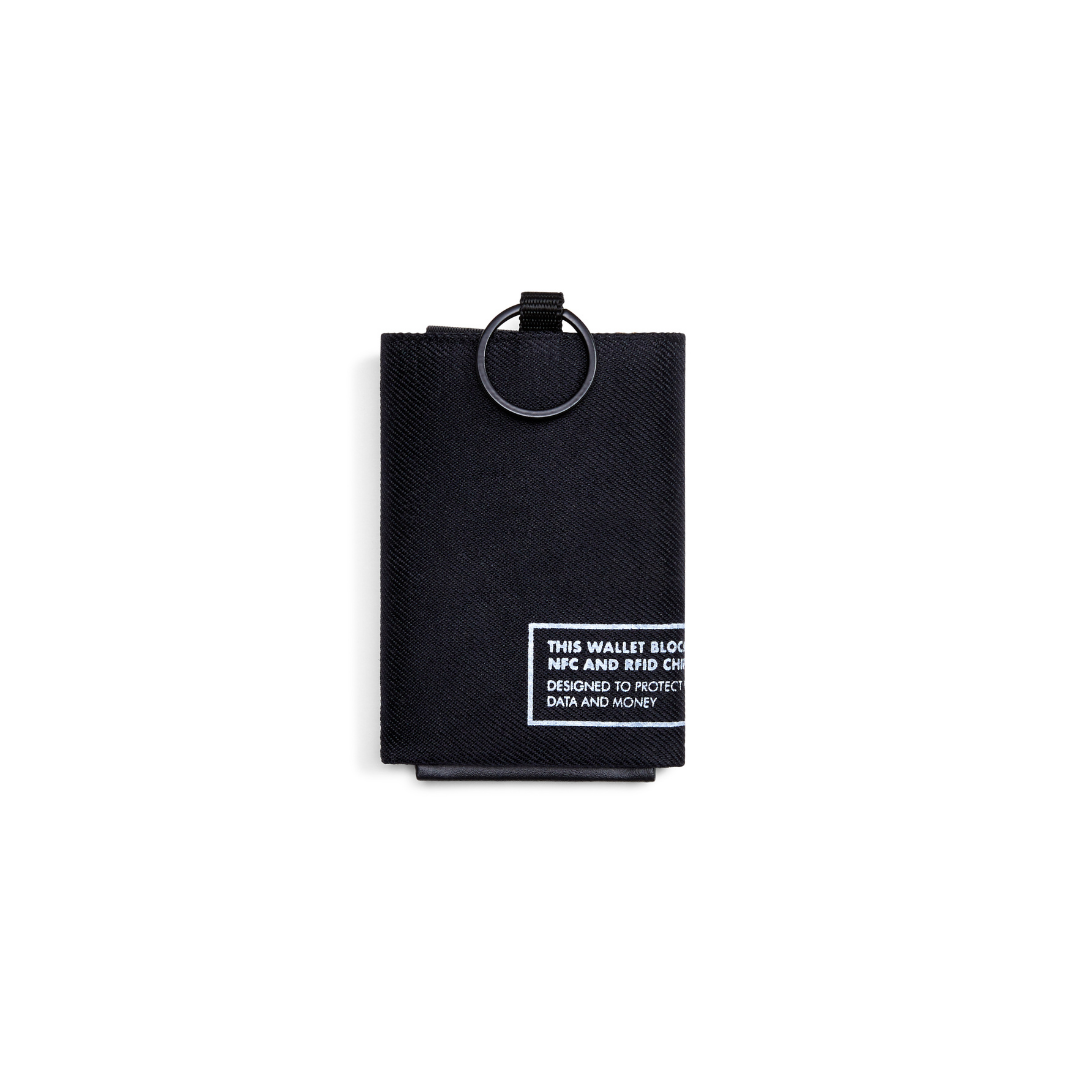
You carry contactless bank, credit or access cards. A wallet with built-in shielding is the practical answer. The cards are in your wallet anyway, so the protection is always active without you having to think about it. See RFID wallets.
You travel with a passport. A passport does not fit in a wallet. It needs its own shielding sleeve, which encloses it fully and protects it from wear at the same time. See passport sleeves.
You need both. Cards and passport are carried separately and need separate shielding. Both products are shown above.
Where RFID protection is not enough
An RFID blocker shields the frequencies used by cards and documents. It does not block the radio signals of a phone, a laptop or a car key.
If you want to take a device fully off the network, blocking mobile, Wi-Fi, Bluetooth and GPS at once, you need a Faraday bag. That is a different product category with a different level of shielding.
What to look for
Shielding in the material. The protection has to sit in the layer that encloses the card or document. A print, a label or a single blocker card in a slot does considerably less than a continuous shielding layer.
Full enclosure. A card sticking half out of its slot is not shielded. The protection only works for what sits completely inside the shielded layer.
Construction over promises. Look at the shielding layer and the build, not the marketing. Stickers, harmonisers and similar products block no signals.
How to test the shielding
- Put the card or passport fully into the shielded compartment.
- Hold the closed product against an NFC-enabled phone or a card terminal.
- No chip should be detected.
If the chip is detected, the card is not fully inside, or the shielding is not working.
Read more: RFID protection in your wallet and Is RFID protection for your passport actually necessary?
TOCA designs and produces protection for cards, documents and devices. Designed in Germany. Built for everyday use.

RFID & NFC
Cards. Passports. Both shielded.
A conductive shielding layer dampens the field that would activate the chip. Passive. No battery.

FAQ
Frequently Asked Questions
What is the difference between RFID protection and a Faraday bag?
An RFID blocker shields the frequencies used by cards and documents. A Faraday bag blocks every radio signal from a device, including mobile, Wi-Fi, Bluetooth and GPS, when it is fully closed. RFID protection is for cards and passports, a Faraday bag is for phones, laptops and car keys.
Do I need both an RFID wallet and a passport sleeve?
If you carry both, yes. Cards and passports are stored separately, and the shielding only works for what sits fully inside the shielded layer. A passport does not fit in a wallet.
Can my passport data be stolen out of my bag?
No. Passport data is protected by Basic Access Control. A reader can only decrypt it after optically scanning the machine-readable line inside the open passport. Without shielding, however, the chip does reveal that a passport is present and, depending on the chip, the issuing country.
Is contactless card skimming a realistic risk?
The risk is often overstated. A reader has to be brought very close to the card, payments are capped, and the PIN, CVV and full card profile cannot be read. What can be read, depending on the card, is the card number and expiry date. If you want to rule that out, you shield your cards.
Will my card and passport still work normally after shielding?
Yes. The shielding is passive and alters neither. As soon as you take them out of the shielded compartment, both work as usual.